
Lake County Directory Runs
The Indiana State Library holdings guide supplies the firmest year-by-year inventory. It lists countywide Polk editions plus separate books for Crown Point, East Chicago, Gary, Griffith, Hammond, and Hobart. Coverage is not an annual roll. A blank year may mean the library lacks that edition, the publisher skipped it, or a city appeared in a combined volume.
| Collection | Years found | Where held | Access |
|---|---|---|---|
| Lake County Polk | 2012, 2015, 2020 | State Library catalog | Check format |
| Crown Point, Robinson's | 1953-1996, selected years | State and local libraries | Print or library-held format |
| Gary, microfilm and Polk | 1908-1919; selected years through 1973 | State and local collections | Microfilm and print |
| Hammond and East Chicago | 1889; Hammond selections through 1980 | State and local collections | Microfilm and print |
| Hobart, Polk | 1962-1991, selected years | Library collections | Check catalog |
Crown Point editions are confirmed for 1953, 1962, 1965, 1968, 1970, 1972, 1974, 1976, 1988, 1990, 1993, and 1996. Griffith has a 1963 Robinson's edition. Cite title, publisher, year, page, city heading, repository, and call number so another researcher can retrace the result.
Lake County Library Access
The Lake County Public Library genealogy service points to the Indiana Room, local directories, histories, newspaper microfilm, obituary indexes, and research databases. Ancestry Library Edition is available on library computers. FamilySearch, Fold3, HeritageQuest, HeritageHub, Hoosier State Chronicles, NewspaperARCHIVE, and local indexes broaden the search. A free genealogy scanner is available at branches.
No single official county historical-society catalog or archival portal was found. Contact the library district serving the city and give staff the exact community and year. Ask whether the item is print, microfilm, or remote-access material. The State Library and local reference desk are essential fallbacks when no scan exists.
The captured State Library Lake County guide connects city directory research with land, naturalization, marriage, obituary, and county indexes.
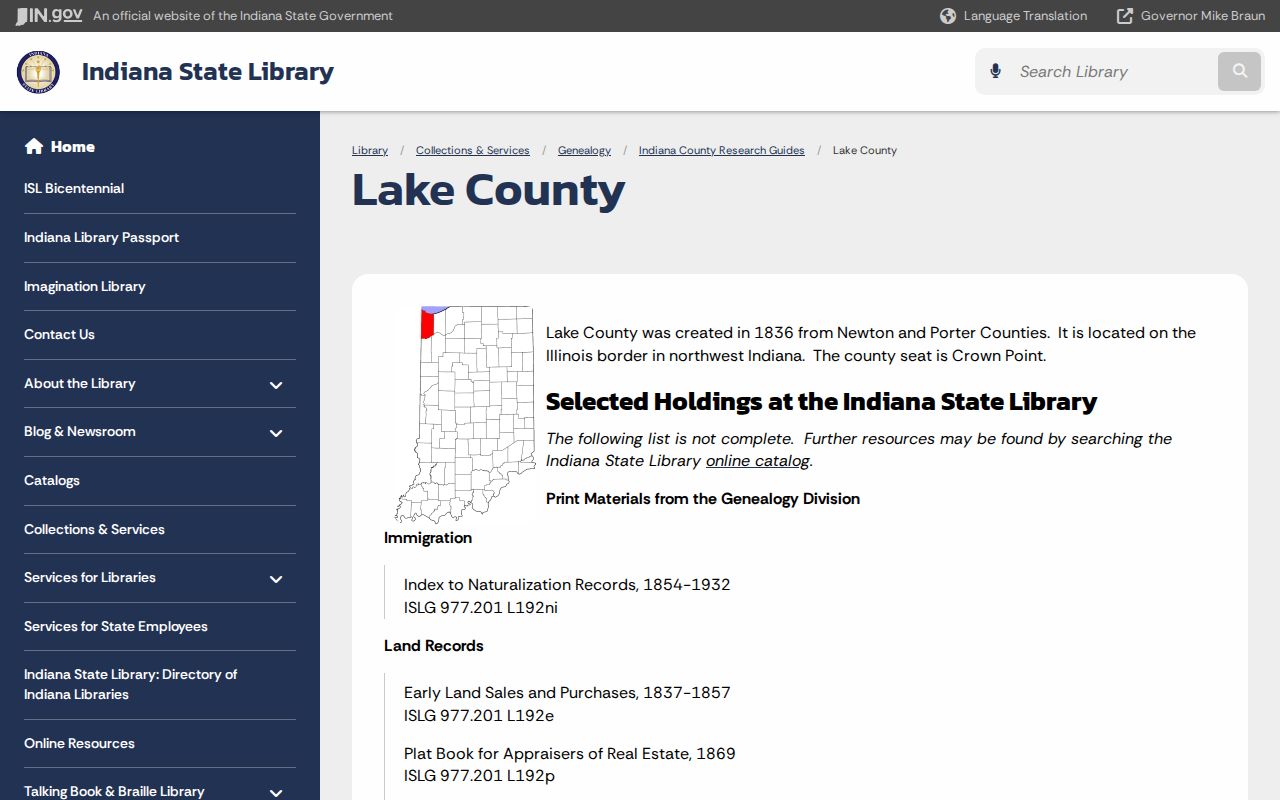
Use it as a finding aid, then note whether each result is an index, image, transcript, or original.
Gary and Hammond Directory Years
Gary has Lake County's longest industrial-city sequence. Microfilm covers 1908 through 1919, with listed editions in 1913, 1915, 1916, 1918, 1920, 1922, 1923, 1925-1927, 1929, 1930, 1935, 1937, 1941, 1945, 1952, 1955, 1957, 1959-1965, 1971, and 1973. Missing years should stay marked as gaps.
Hammond has an 1889 Hammond/East Chicago item, Smith's editions for 1911 and 1912, microfilm runs in 1917-1919, 1921-1924, 1926-1929, and 1948-1958, and selected Polk years through 1980. A combined title can cover East Chicago, Indiana Harbor, or Whiting. Record the city heading before copying a name.
Read Lake County Directory Entries
A city directory line is a dated publication entry, not proof of full-year residence. Transcribe the printed details. An entry can describe a person, household, boarder, widow, shop, institution, or property owner. Publisher symbols change, so save the abbreviation page.
| Name | Surname, given name, and initials as printed |
|---|---|
| Place | City heading and street section |
| Address | Number, direction, and street name |
| Context | Spouse marker, phone, business, occupation, or cross-reference |
| Citation | Edition, page, repository, and call number |
Telephone and occupation fields may distinguish same-name entries. They should not become claims about anyone today.
- Criss-cross directory
- A section arranged by street and house number rather than surname.
- Householder index
- An address list naming the person or entity tied to a dwelling.
- Abbreviation key
- The publisher's legend for short forms and symbols in that edition.
Lake County Criss-Cross Checks
The holdings guide does not identify a complete reverse-directory run. Some books may have a street section. Inspect each edition's front matter and index. Find the house number, copy the occupant spelling, then return to the alphabetical entry for context.
Publication lag matters. An address can be absent because the book omitted a household, a subdivision was new, a street number changed, or a person moved before publication. Check editions before and after the target year. Current address work belongs in the Lake County street directory, not an old volume.
Digitized Lake County Collections
The Indiana genealogy Lake County collection links East Chicago telephone books from 1926 through 1931, issued twice yearly by Illinois Bell. It also links church histories for Highland and Hammond, a St. Mark's parish history in Gary, and Munster High School yearbooks.
Each can fill a documented gap without being mislabeled as a city directory. A telephone book may confirm a line, a church history may explain a family or institution, and a yearbook may test a school-age name. Local staff are the fallback when scans omit pages.
Lake County Names in Newspapers
The LCPL obituary database accepts name, partial name, maiden name, date, city, and age. Its runs include Crown Point material from 1857, Hobart Gazette entries from 1891, Lowell Tribune from 1920, Post Tribune from 1921, Hammond Times material, and Whiting items from 1919. The Post Tribune range for 1987-1989 is incomplete.
An index hit is a pointer. Verify it on microfilm or a page image. The local newspaper inventory separates Crown Point, Gary, Hammond, Hobart, Lowell, and other community titles, so search the right place and date.
Lake County Maps Test Addresses
Sanborn fire-insurance maps add a dated building footprint, use, street label, and block number. Crown Point has a nine-sheet 1910 set, Gary a twelve-sheet 1908 set, and Hammond a 126-sheet 1915 set that includes East Chicago, Indiana Harbor, and Whiting. The East Chicago 1930 set has 103 sheets but is cataloged as unavailable online.
Maps and city directories answer different questions. A map shows the structure. A directory may name an occupant. A deed records a legal transfer, while a newspaper may report a life event. Keep those evidence types in separate notes.
Trace Lake County Directory Families
Build a chain of dated observations rather than assuming a surname stayed at one address between editions.
- Choose the community and nearest confirmed edition.
- Copy the page, spelling, address, and printed household marks.
- Check adjacent editions and any street section for a move.
- Pair the entry with the nearest public federal census.
- Test the address in maps, newspapers, obituaries, or deeds.
If a name vanishes, search nearby editions and papers before deciding why. The person may have moved, died, changed spelling, or been omitted. A directory find can support a modern Lake County resident lookup, but cannot replace current evidence.
County formation in 1836 also explains why early family evidence sits outside the printed shelf. Land sales, original-owner lists, appraiser plat books, naturalization indexes, WPA vital indexes, and later municipal files are held by different offices and repositories. Crown Point served as the county seat while Gary, Hammond, East Chicago, Whiting, Hobart, and other communities built their own newspaper and directory traditions. Search the city named in the record, then follow the repository that created or preserved it.
A useful research log has one row for each edition. Record the searched spelling, city heading, street address, page, repository, and result, including a clear note when nothing was found. Negative evidence needs restraint. No entry may reflect an omitted household, a missing book, a new subdivision, a change in street number, or a name filed under another form. Adjacent editions and the newspaper run help distinguish those cases.
When a directory address conflicts with a deed or map, do not force agreement. The deed may use a lot and block, the map may predate the current number, and the book may have been compiled months before publication. Preserve each date and wording. That record-by-record method is slower, but it produces a family or house history that can be checked by someone else.
Keep evidence dated. Use Lake County city directories for family history and lawful research, never to track or harass a living person.